April 23, 2025 - Greece
Acropolis Museum
|
|
Approaching the Acropolis Museum after touring the Acropolis itself. The museum was built to house every artifact found on the Acropolis and on the surrounding slopes, from the Greek Bronze Age to Roman and Byzantine Greece. It opened to the public on 20 June 2009. The original museum was on the Acropolis itself. But it wasn't big enough to handle the number of artifacts; a new facility was needed.
An additional motivation for the construction of a new museum was so when the Greeks made requests for the repatriation of the Elgin Marbles from the British Museum, there would be world-class facility in which to display them.
The Elgin Marbles are a collection of Ancient Greek sculptures from the Parthenon and other structures from the Acropolis of Athens, removed from Ottoman Greece in the early 19th century and shipped to Britain by agents of Thomas Bruce, 7th Earl of Elgin, and now held in the British Museum in London.
|
| |
 |
|
| The museum's glass walls give the following view of the Acropolis and Parthenon. |
| |
 |
|
|
On the entrance floor were these fascinating dioramas about the Acropolis' evolution from 480 BC to 1500 AD.
This is the Acroplis in 480 BC on the even of the Persian invasion. The large finished temple left of center is the Old Temple of Athena Polis. The Older Parthenon is under construction at center.
|
| |
 |
|
|
The Acropolis in the 5th Century BC. The Parthenon, Propylaea, and Erechtheion are all in place, newly constructed. Most of the major temples, including the Parthenon, were rebuilt by order of Pericles during the so-called Golden Age of Athens (460–430 BC).
Behind the Propylaea, Phidias' gigantic bronze statue of Athena Promachos ("Athena who fights in the front line"), built between 450 BC and 448 BC, dominated. The base was 4 ft 11 in high, while the total height of the statue was 30 ft. The goddess held a lanceand a giant shield on the left side.
On the southern slope the Theatre of Dionysos may be seen, with the covered Odeion of Periles -- a building built for musical activities -- behind it. |
| |
 |
|
|
The Acropolis in the 2nd - 3rd Centures AD during Roman rule.
The big additions were the huge Odeon of Herodes Atticus at lower right. Notice the covered roof. From the Odeion runs a long building called the Stoa of Eumenes (Portico) that runs to the expanded Theatre of Dionysos.
|
| |
 |
|
| Another look at the Acropolis during the Roman era. I couldn't get over how large the Odeon of Herodes Atticus was. As was the Stoa of Eumenes and Theatre of Dionysos. |
| |
 |
|
| One more look at the Acropolis in the Roman era. |
| |
 |
|
|
Now we see the Acroplis in the early 15th Century AD. All the temples, including the Parthenon, have been converted into churches. A medieval wall has been built around the Acropolis.
Constantinople fell to the Ottomans in 1453, Athens in 1456, and the Peloponnese in 1460. By 1460 all of mainland Greece had been conquered, not to be regained by the Greeks until the successful Greek War of Independence broke out in 1821 and the First Hellenic Republic was proclaimed in 1822.
After the Ottoman conquest of Greece, the Propylaea were used as the garrison headquarters of the Turkish army, the Parthenon was converted into a mosque and the Erechtheum was turned into the governor's private harem. The buildings of the Acropolis suffered significant damage during the 1687 siege by the Venetians in the Morean War. The Parthenon, which was being used as a gunpowder magazine, was hit by artillery and damaged severely.
|
| |
 |
|
|
Athens in the 2nd-century AD during Roman rule, looking west. How small the city is -- just a settlement around the Acroplis -- compared to today, when this entire area is covered with urban sprawl.
At lower left is the Panathenaic Stadium. The huge Temple of Olympian Zeus is fully complete in all its glory. The Lliissos River runs at lower left.
A wall surrounds the city.
|
| |
 |
|
|
From this angle, looking southeast, you can see the Ancient (Greek) Agora, Roman Agora and Library of Hadrian.
The city wall gate at bottom center is Dipyon Gate.
|
| |
 |
|
|
A model of the Propylaea shows how this entrance gate once looked -- a grand, steep staircase that led the visitor up, up, up, and then through majestic columns, to emerge atop the Acropolis.
|
| |
 |
|
| A model of the Parthenon in its prime. The triangular area at top is called the pediment. The band of sculptures below it are the metopes. |
| |
 |
|
| Other side of the Parthenon. |
| |
 |
|
| Cut-away showing how the Greeks built the roofs from wood. |
| |
 |
|
|
Reconstruction of the Parthenon's west pediment of the Parthenon. The Parthenon's west pediment depicts the contest between Athena and Poseidon over Attica..
|
| |
 |
|
|
Reconstruction of the Parthenon's east pediment of the Parthenon according to a drawing by K. Schwerzek (1904). The Parthenon's east pediment depicts the birth of Athena.
Classical archeologists since Johann Joachim Winckelmann (1764) have recognized Greek pediment sculpture, in particular the pediments of the Parthenon, as the standard of the highest-quality art in antiquity.
The Parthenon pediments are almost the only classical example to substantially survive in the original site since the Renaissance.
Numerous careful drawings were made in Athens in 1674 by Frenchman Jacques Carrey. These were made before the sculptures were greatly damaged in an explosion in 1687. The drawings had all reached Paris by Carrey's return in 1679, and contain crucial evidence as to the original appearance of the portions that were destroyed.
The British Museum holds 17 figurative pedimental sculptures from the Parthenon, as part of the so-called Elgin Marbles, in their permanent collection. The rest of the pedimental sculpture from the Parthenon are on display here in the Acropolis Museum.
|
| |
 |
|
| Another view of the east pediment. The horse heads at right can still be seen on the Parthenon. |
| |
 |
|
|
Close-up of the horse's heads.
|
| |
 |
|
| The elegant Erechtheion (or or Temple of Athena Polias) -- constructed of Pentelic marble between 421 and 406 BC -- was by a complex plan which took account of the extremely uneven ground and the need to circumvent several shrines in the area. The entrance, facing east, is lined with six Ionic columns. Unusually, the temple has two porches, one on the northwest corner borne by Ionic columns, the other, to the southwest, supported by huge female figures or caryatids. The eastern part of the temple was dedicated to Athena Polias, while the western part, serving the cult of the archaic king Poseidon-Erechtheus, housed the altars of Hephaestus and Voutos, brother of Erechtheus. Little is known about the original plan of the interior, which was destroyed by fire during the first century BC and has been rebuilt several times. |
| |
 |
|
|
|
| |
 |
|
| How did the Greeks build the Parthenon and other temples? Perhaps they used a crane like this? |
| |
 |
|
|
Of course, no diorama collection would be complete without a Lego diorama!
|
| |
 |
|
| Pottery found near the Acropolis -- no one lived on top of the Acropolis. |
| |
 |
|
|
|
| |
 |
|
| |
| |
 |
|
|
Level Three is the Parthenon Gallery, which is cleverly designed to re-create teh dimensions of the Parthenon. The stainless-steel columns mark the location of each marble column. The relief panels once ringed the Parthenon.
The darker-brown panels are originals. The white plaster ones are copies of the originals in other museums, mainly the British Museum.
The sculptured reliefs on the lower band are called Friezes. The sculptures up higher attached to the stanless-steel columns are called Metopes.
|
| |
 |
|
|
An original metope, severly damaged.
|
| |
 |
|
| Copied frieze at left, original at far right. |
| |
 |
|
| Copied metope. |
| |
 |
|
|
Copies of friezes.
The marbles acquired by Elgin starting in 1801 include some 21 figures from the statuary from the east and west pediments, 15 of an original 92 metope panels depicting battles between the Lapiths and the centaurs, as well as 75 metres of the Parthenon frieze which decorated the horizontal course set above the interior architrave of the temple. As such, they represent more than half of what now remains of the surviving sculptural decoration of the Parthenon.
Plaster casts of the marbles were in high demand and were distributed to museums, private collectors and heads of state throughout the world.
|
| |
 |
|
|
Everything known about the statues that adorned the Parthenon has been re-created on this floor in the Acropolis Museum.
|
| |
 |
|
| All that is left of the pediment sculptures with metopes (upper) and friezes (lower) behind them. |
| |
 |
|
|
More pediment scupltures (or what's left of them)
|
| |
 |
|
|
Level One has statues from the Acropolis' first temples, a century before the Parthenon.
Per Rick Steves, the Acropolis has two layers of history; before the Persian sacking in 480 BC (Archaic) and after (Golden Age or Classical). The Archaic statues survived because they were bured under later Acropolis buildings before being excavated in the 1800s. Only the Classical remains of what was rebuilt after 480 BC.
|
| |
 |
|
| The ramp up to Level One. |
| |
 |
|
| Looking down at five of the original six lady-columns that once supported the roof of the prestigious Erechtheion temple. |
| |
 |
|
| The six on the Acropolis are copies; the other original is in the British Museum. |
| |
 |
|
|
|
| |
 |
|
|
These sculptures were structurally functional columns.
|
| |
 |
|
| |
| |
 |
|
|
This statue adorned the entrance to the first great temple on the Acropolis (from 570 BC). It was called the Hekatompedon ("100-foot-long") for its legendary size. The temple was dedicated to Athena, the patron of the city of Athens, and it stood in the Acropolis' prime location -- where the Parthenon is today.
Here, bearded Hercules wrestles with the dragon-tailed sea monster Triton (still colorful with 6th-century BC paint).
|
| |
 |
|
Bust of Emperor Lucius Verus who was, along with Marcus Aurelius, was co-emperor from 161 AD until his deatah in 169 AD. |
| |
 |
|
| Sculptured relief of an ancient Athenian trireme, with bronze bow ram. |
| |
 |
|
| As you usually see statues in their natural stone, it's easy to forget that many of them were painted. This is the rare statue that still has its original colors. |
| |
 |
|
|
A painting of the Acroplis in its prime, during the Golden Age. It was painted by Leo von Klenze in 1846. The painting resides in the Neue Pinakothek, Munich. (Lynnette and I were in Germany two years ago and went to the Alta Pinakothek (Old Museum) but the Neue Pinakothek (New Museum) was closed for renovation at the time, unfortunately.)
|
| |
 |
|
|
A beautiful photo of the Acropolis, looking from the south, taken by Alexander Popkov. (Wikipedia)
"The buildings of the Acropolis -- Propylaea, Parthenon, Erechthelon -- were all constructed within about a 5--year span, and they were intended to complement one another." ... Rick Steves
|
| |
 |
|
|
The Acropolis from the west; photo by David Garnand (Wikipedia)
|
| |
 |
|
|
The Acropolis brilliantly lit up from the north Photo by Stymphal
|
| |
 |
|
|
Another shot of the Acropolis from the north; Photo by George E. Koronaios
|
| |
 |
|
|
The museum sits above a 6th-century BC excavation site.
|
| |
 |
|
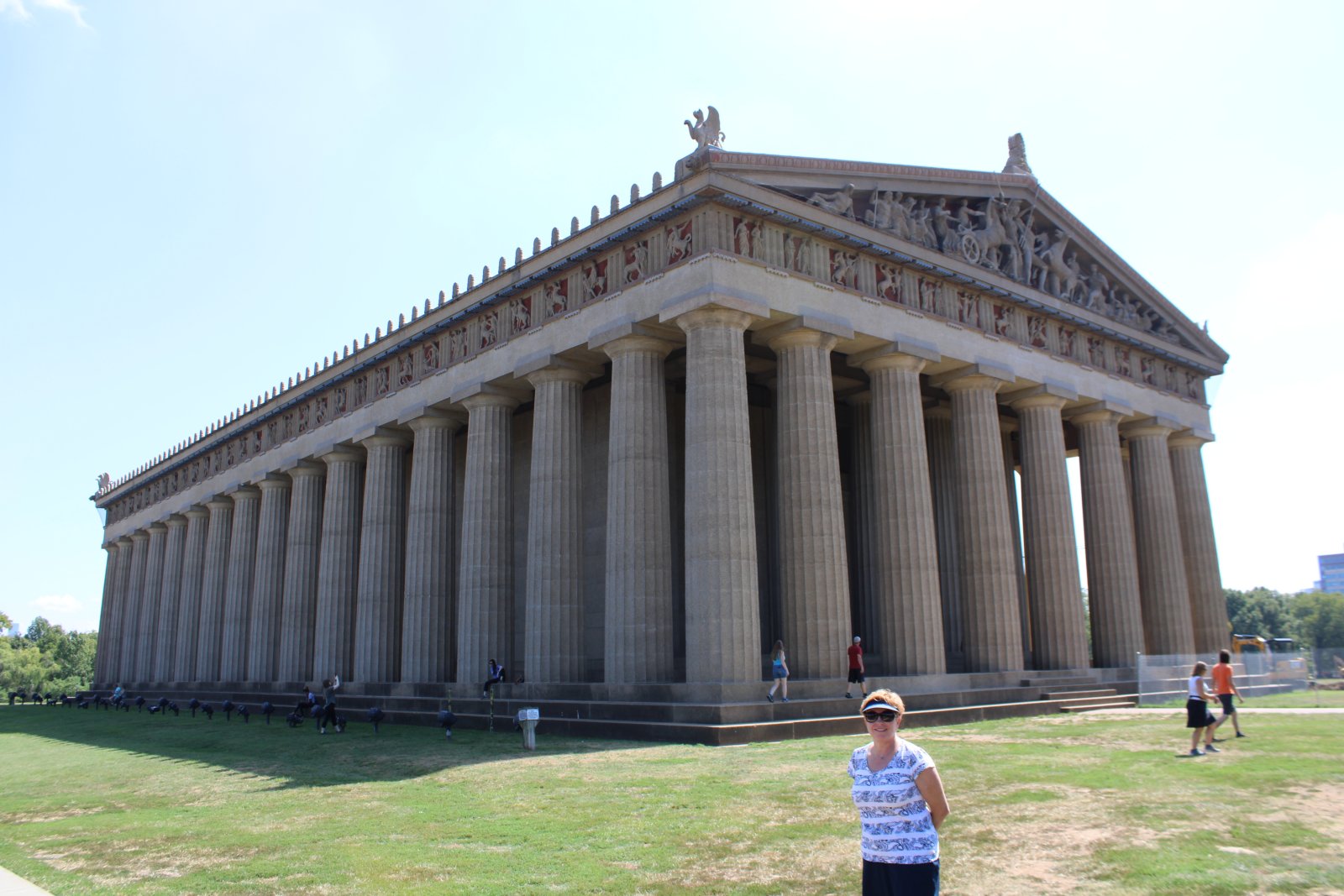
Want to see what the Parthenon looked like back in the Golden Age? Go to Centennial Park, Nashville, Tennessee! There sits the world's only full-scale replica of the original Parthenon. To see more pictures of the replica Parthenon from our visit back in September 2023, click here. The replica has the pediment and metope sculptures but not the friezes. |
| |
 |
|
|
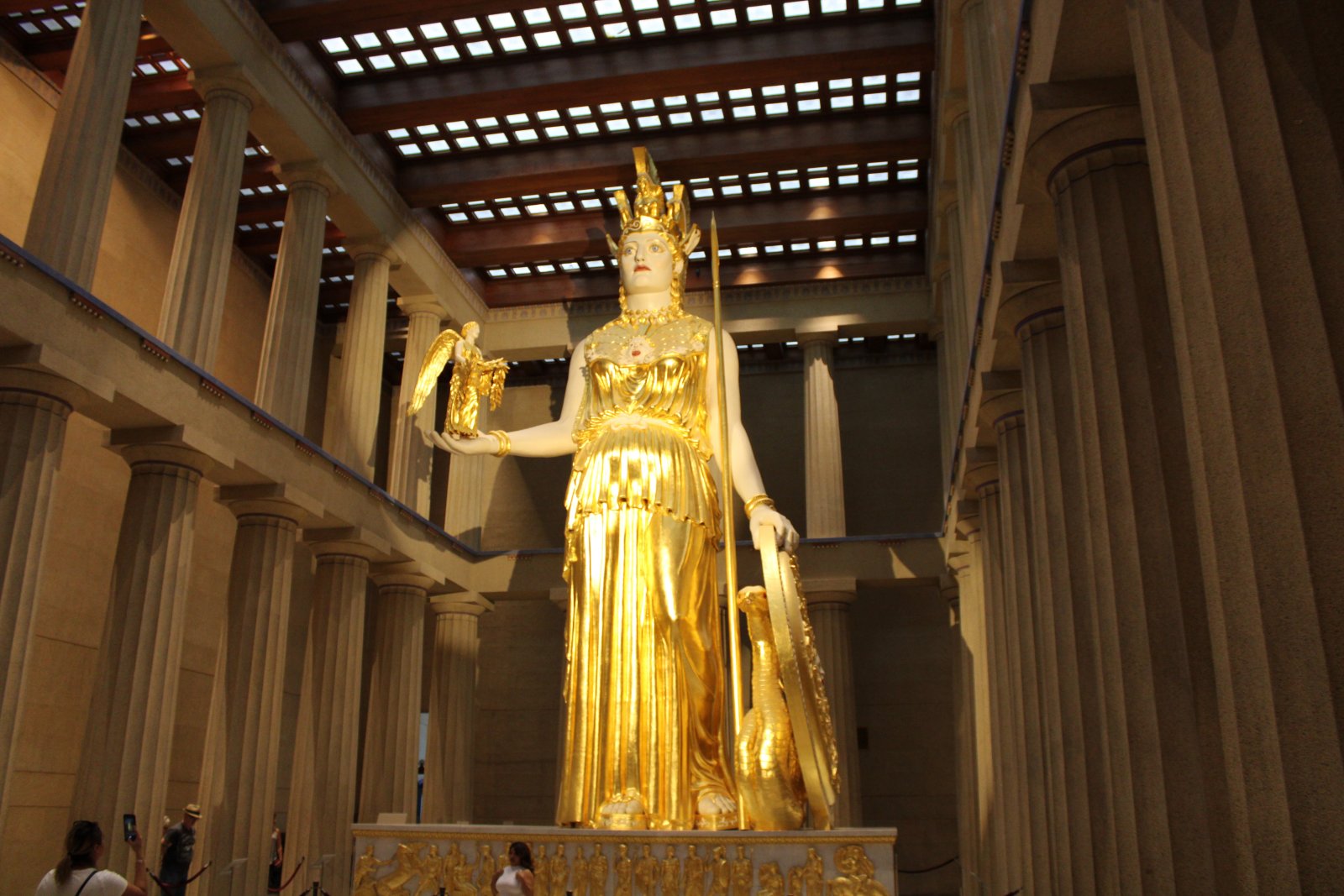
Inside the replica Parthenon is the gilded and painted giant statue of Athena Parthenos.
|
| |
 |
|
| |
| |
|
|
|
|
|
|